There's a question circulating among enterprise CIOs and CTOs that wedding technology vendors should be reading very carefully. Deloitte put it bluntly in a July 2026 analysis: if an AI agent can reason through a task, call the right tools, and complete the work autonomously, what exactly do we need SaaS for?
The answer Deloitte arrived at — and the one we would apply directly to the wedding industry — is that agentic AI is not the end of SaaS. It is most likely the end of SaaS as a category defined by applications. The unit of value is shifting from a user logging into an app to the action an agent completes. And that shift, multiplied across every corner of wedding operations, is going to redraw how wedding software is built, priced, and used over the next three to five years.
Swap enterprise for wedding business and the example for something closer to home: today, a wedding planner logs into their CRM, their venue sourcing tool, their client portal, and their invoicing platform to manage a single event. Tomorrow, an agent could handle the routine coordination overnight — pulling vendor availability, drafting contracts, chasing outstanding payments, flagging anything that needs a human decision. The vendor is no longer selling workflow software. It is selling booked weddings. That is the shift.
The Three Pressure Points — Applied to Wedding Tech
Deloitte identifies three areas where agentic AI puts structural pressure on SaaS business models. Each one maps cleanly onto the wedding technology landscape.
1. Pricing
Wedding SaaS has largely followed the broader industry's per-seat and per-user model. HoneyBook charges per member. Aisle Planner prices by tier. Planning Pod charges by active events. These models were built for a world where humans are the unit of work — every user who logs in justifies a license.
Agentic AI breaks that assumption. A single wedding planner supervising a team of agents can handle the administrative workload of three planners running purely manual operations. The per-seat price becomes hard to justify when seats aren't the constraint anymore. At the same time, usage-based pricing — charging for API calls or token consumption — creates unpredictable bills, particularly during peak season when agents are running automations constantly.
What emerges instead is likely a hybrid model: a base subscription covering access and data storage, layered with outcome-based components. Think per contract executed or per confirmed booking rather than per user per month. A few wedding tech vendors are already experimenting near this territory — HoneyBook's Smart Files and automated payment features gesture toward outcome orientation — but no one has fully committed to the model yet.
2. Interfaces
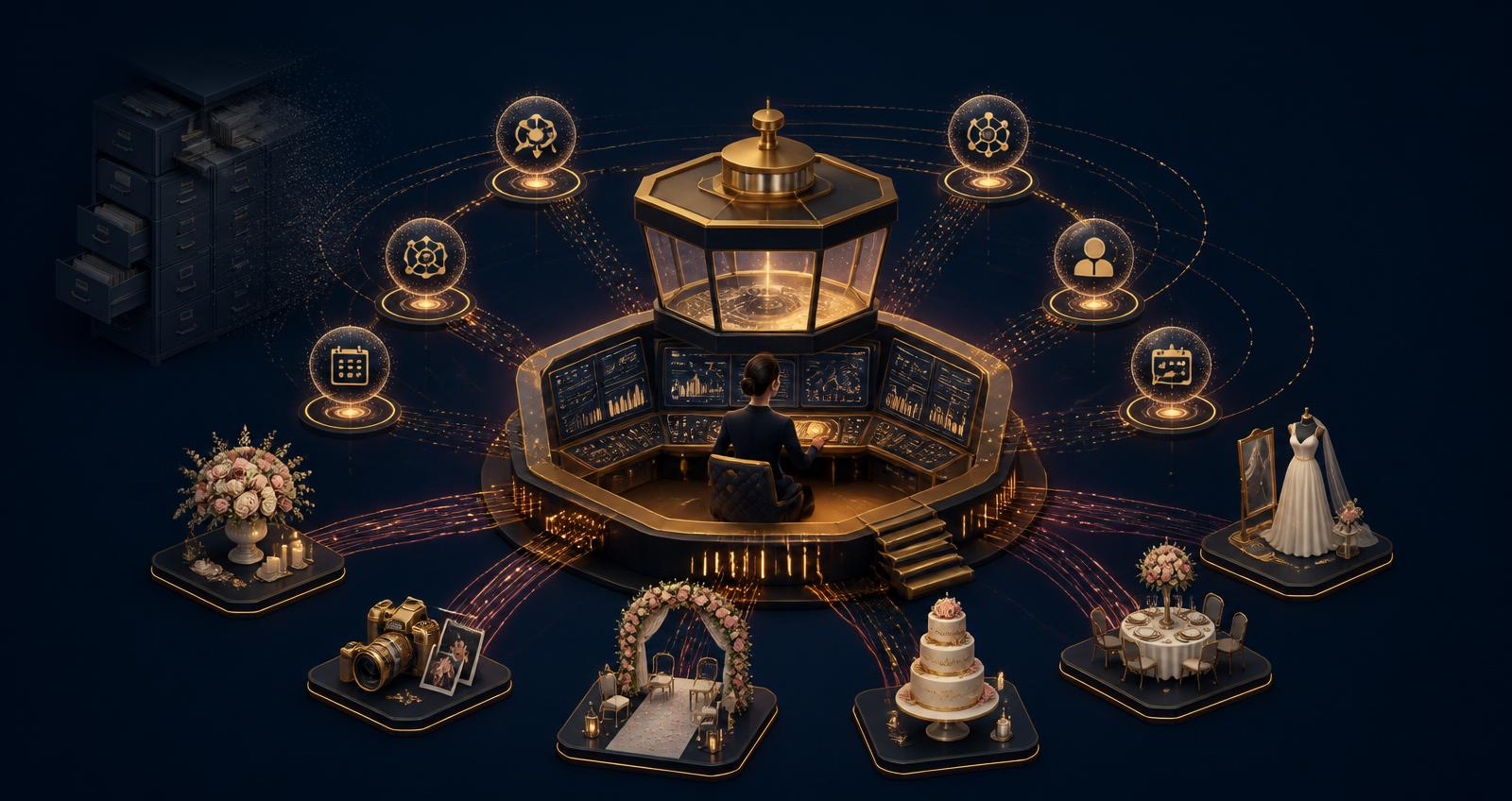
When agents do the work, the application's user interface becomes a control center rather than a workspace. Wedding planners may spend far less time inside their tools and far more time reviewing what their agents did overnight — approving a contract draft, flagging a venue conflict, or stepping in when a vendor relationship needs a human touch.
This raises a question that wedding SaaS vendors haven't adequately answered: where does that control center live? Inside a single vendor's platform? In a neutral dashboard that sits above multiple tools? Or directly in whatever communication surface the planner already lives in — email, WhatsApp, Slack?
The historical precedent in enterprise is instructive. The vendors who owned the control layer — the dashboard where you saw everything — tended to commoditize the tools underneath. In wedding tech, that would mean whoever owns the unified agent oversight view for a planning business holds enormous leverage over every other SaaS tool in the stack. It's not obviously any of the current incumbents. It might be a new entrant, or a platform like Google Workspace or Microsoft 365 that quietly absorbs the orchestration layer as it has done in enterprise.
3. Orchestration
No wedding business — even a boutique solo planner — runs on a single vendor. The average mid-size planning business subscribes to roughly a dozen SaaS tools: a CRM, a contract platform, a client portal, a venue database, a floor plan tool, a timeline builder, a payment processor, a photo delivery platform, and a handful of communication and project management tools besides.
Running agents across that stack requires orchestration. Something needs to know what each tool can do, route tasks to the right agent, handle failures gracefully, and report back to the human in a way they can actually understand. Right now, that orchestration layer doesn't exist in wedding tech in any mature form. Which means the race is on.
Three different types of players are competing to own it. Incumbent suites like The Knot Worldwide are pushing to embed agents into their existing vendor ecosystem, keeping orchestration inside their walled garden. AI-native newcomers are betting that a lightweight orchestration layer above all the tools will eventually commoditize the underlying applications entirely. And cloud infrastructure providers — think Google, Microsoft, AWS — are positioning their AI platforms as the natural home for multi-agent coordination, which would put them upstream of every wedding SaaS vendor simultaneously.
Where Today's Wedding SaaS Vendors Actually Stand
The wedding tech landscape is not uniform in its exposure to this shift. CRM and workflow platforms like HoneyBook and Dubsado carry high exposure — core workflow automation is prime agentic territory, and first-mover advantage on outcome pricing is available to whoever moves. Marketplace platforms like The Knot, WeddingWire, and Zola face equally high exposure: agents will disintermediate discovery, and vendors who own the agent layer keep the moat while those who don't lose lead flow.
Photo and video platforms — Pic-Time, Pixieset, Shootproof — carry lower exposure because creative delivery is naturally human-adjacent; face recognition and auto-curation are features, not existential threats. Venue and catering management tools like Tripleseat and Caterease sit in the middle: availability management and BEO generation are automatable, though human sign-off on contracts preserves some stickiness. Guest experience platforms like Zola Registry and Joy retain emotional surface area that makes full automation unlikely, though RSVP and comms are agentic-ready now. Payments and contracts — HoneyBook Pay, Bloom, Sprout Studio — carry the highest disruption potential: end-to-end payment and contract execution is exactly where outcome-based pricing lives.
What Wedding Professionals Should Actually Do
Build a data foundation first. Agents are only as good as the data they can access. Before any wedding professional can meaningfully deploy AI agents, they need their client data, vendor relationships, pricing history, and communication records in a structured, accessible state. Most wedding businesses operate with data scattered across inboxes, spreadsheets, and disconnected SaaS tools. Agents will expose that gap the moment they try to act on it. Consolidating into a proper CRM with clean records isn't just a hygiene task — it's the prerequisite for the agentic future.
Renegotiate your SaaS relationships. Deloitte recommends that enterprise buyers build agentic clauses into their SaaS renewals — covering data portability, agent integration rights, and transparency around usage. Wedding professionals should think in the same terms. When renewing with your CRM, your contract platform, or your venue management tool, ask explicitly: can an AI agent access my data via API? Can it take actions on my behalf? What does that cost? Who owns the outputs? Vendors who can't answer these questions clearly in 2026 are going to be behind the curve when the shift accelerates.
Decide on your orchestration approach deliberately. The most consequential architectural decision a wedding business will make in the next three years isn't which CRM to use. It's which platform or agent framework sits above all their tools and coordinates them. Going all-in on a single vendor's ecosystem offers simplicity but creates lock-in. Building a neutral layer — using something like Zapier AI, Make, or a custom Claude integration — preserves flexibility but adds complexity. Both approaches are defensible. Defaulting to whatever each individual SaaS vendor pushes as their AI feature is not a strategy; it's drift.
Train yourself as an agent supervisor, not an agent user. The job is changing. Not disappearing — changing. The skills that matter in an agentic workflow are different from those in a manual one: setting clear goals for agents, reviewing their outputs critically, knowing when to override and when to trust, and maintaining the client relationships that no agent can replicate. Wedding professionals who start practicing these skills now — even with simple automations — will have a meaningful advantage over those who delay until the transition is forced on them.
The Opportunity Nobody's Talking About
The macro SaaS disruption Deloitte is describing at the enterprise level creates a specific opening in the wedding industry. The largest players — The Knot Worldwide, Zola, WeddingPro — have the most to lose from agentic disintermediation of their discovery and lead-generation business. That same disruption is the best thing that could happen for independent wedding professionals and the smaller SaaS platforms that serve them.
If an agent can pull together a vetted shortlist of photographers in a given region without ever touching The Knot's marketplace, the monopoly on wedding discovery weakens. The vendors, photographers, and planners who've built direct relationships and a real web presence stand to gain. The platforms whose value was aggregating and gatekeeping information stand to lose it. This is not a distant scenario. It is a current one. The couples planning 2027 and 2028 weddings are already using AI-assisted search in ways that bypass traditional marketplace discovery. The structural shift is underway.
The Bottom Line
Agentic AI is not coming for wedding SaaS as a category. It is coming for wedding SaaS as it currently exists: built around the assumption that a human logs in, clicks through, and manages everything manually. The vendors that adapt — restructuring pricing around outcomes, building APIs that agents can actually use, and positioning themselves as part of an orchestrated stack rather than a self-contained application — have a significant opportunity. The vendors that treat agentic as a feature to add to an existing model will find that feature insufficient.
Deloitte's framing is exactly right: this is a structural shift to architect for, not a product update to consume. The window to make these decisions deliberately is open now in the wedding industry. The enterprise world is moving fast. Wedding tech, historically a follower, has perhaps eighteen to twenty-four months before the same dynamics arrive with less warning and less time to prepare.
The enterprises that lead the next decade will be those that redesign their workflows around what agents can do — removing the friction that has accumulated from layered SaaS investments and putting human talent back on the work that actually requires it. In wedding terms: less time inside software, more time with clients. That's not a bad outcome for an industry that is, at its core, about people.
References
- Deloitte Insights: With The Rise Of Agentic, Has SaaS Seen Its Moment? — Girija Krishnamurthy, July 22, 2026. deloitte.com
- Deloitte Global TMT Predictions 2026. deloitte.com
- The Business Research Company: Wedding Service Global Market Report 2026. thebusinessresearchcompany.com