Every wedding directory in the world sells the same thing: impressions. A couple lands on a listing, maybe clicks a contact button, maybe fills out a form, and then the vendor waits. Sometimes for hours. Sometimes for days. Most of the time, forever. The industry has quietly accepted a lead-to-booking ratio that would be considered malpractice in any other vertical.
IAM was built to end that. It is the conversational close engine at the top of the IAM parent stack — the first of four programmatic backend pillars, and the one that changes what a vendor is actually paying for when they list on a modern wedding platform. Not a spot in a directory. A closed booking.
What IAM Actually Is
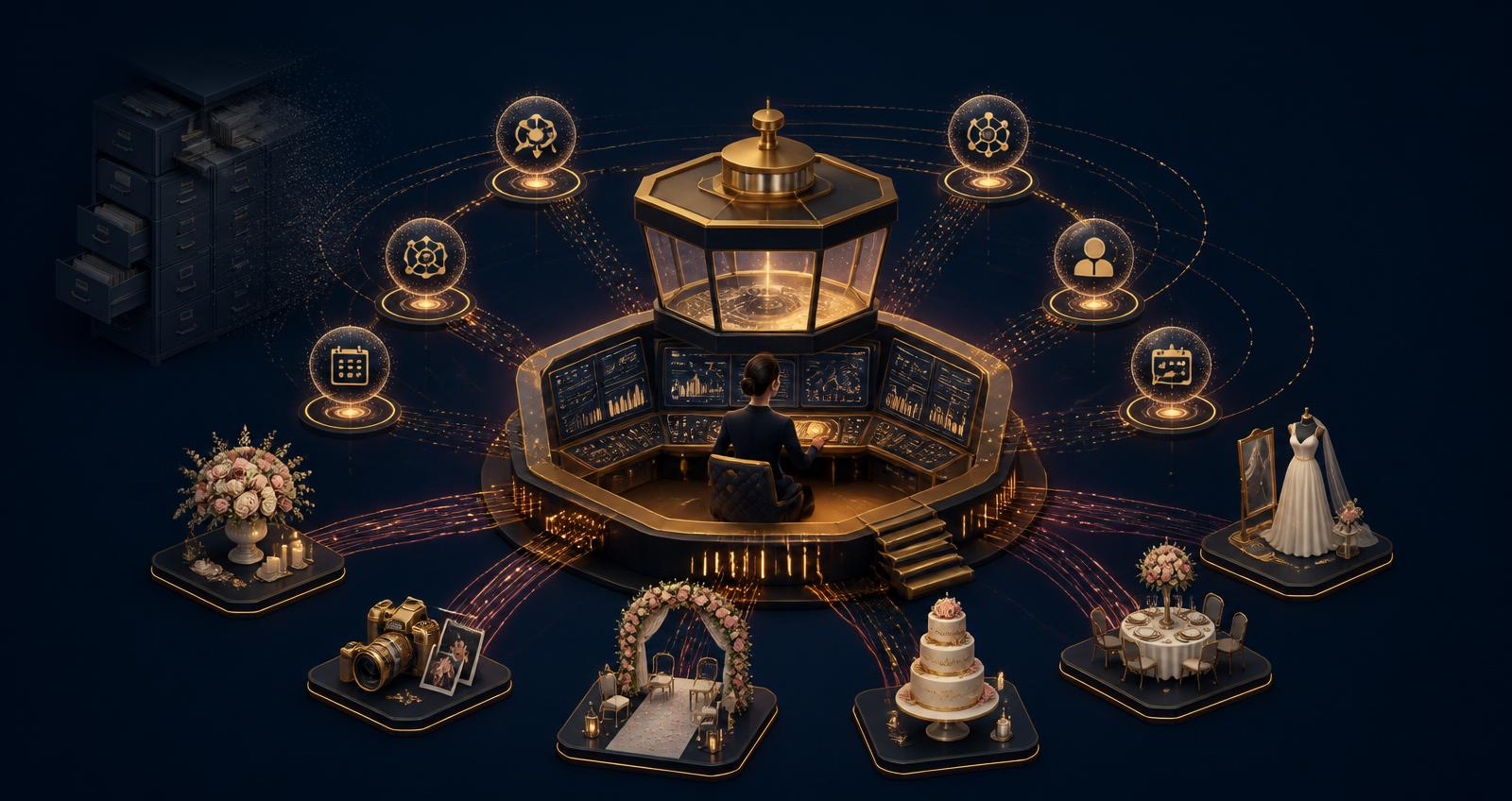
IAM is an AI bot layer that sits on top of every vendor profile, every landing page, and every syndicated listing across the IAM network — including its wedding-industry operating subsidiary, Weddings.io Technologies. When a couple arrives on a florist's page at 11:47pm on a Tuesday, IAM does what a human sales rep would do if a human sales rep existed at 11:47pm on a Tuesday. It greets. It qualifies. It asks the four questions that matter — date, guest count, budget band, ceremony style — and it books the consultation before the couple ever clicks away.
The bot is trained on the specific vertical it serves. It knows the difference between a South Asian ceremony budget and a courthouse elopement budget. It knows which questions matter to a photographer versus a caterer versus a live wedding band. It routes to the vendor's calendar, their CRM, their SMS, or all three. And it does it in the couple's language, at their pace, without pretending to be human.
Why This Is A Pillar, Not A Feature
The distinction matters. Chat widgets have existed on wedding sites for a decade. Most of them are lipstick on a contact form. IAM is architectural — it is one of the four pillars underneath the entire IAM delivery stack, alongside content syndication, spatial planning, and enterprise CRM, all operated in-market through Weddings.io Technologies.
That means IAM does not just answer questions. It writes back into the data graph. Every conversation feeds the vendor verification layer, the territory intelligence system, and the syndication engine. A couple who asks IAM about a specific venue in a specific city on a specific date generates a signal that travels across the platform — informing pricing, availability, editorial coverage, and the market map WeddingSaaS publishes as an arm of the same parent.
The Economics Nobody Wants To Say Out Loud
The directory model prices vendors by visibility. IAM lets vendors be priced by outcome. That is a different business, and it is the business every wedding vendor actually wants to be in.
A $10/year listing plus a conversational close engine that converts at real e-commerce rates is not the same product as a $400/month directory feature bundle with a contact form. It is a categorically different offer. The first sells access to a verified network. The second sells hope.
Where IAM Fits In The Four-Pillar Stack
Pillar One — IAM, The Closer — routes and books the lead. Pillar Two — The Proof Engine — syndicates the resulting content across social, search, and press. Pillar Three — The Execution — handles spatial and experiential planning once the booking is signed. Pillar Four — The Business Engine — closes the loop with enterprise CRM and vendor financials. IAM is the front door. Everything else is what happens once a couple walks through it.
This is what a wedding operating system looks like when the AI is structural. Remove IAM and the stack still exists on paper, but the top of the funnel goes cold overnight. That is the test for infrastructure versus feature: what breaks when you take it out.
What To Watch Next
IAM's next expansion is multilingual conversational close across the 24 country territories its Weddings.io Technologies subsidiary operates in — including full South Asian, Mandarin, Arabic, and Spanish ceremony flows. The bot is also being wired into TALC, the post-event review engine, so the same conversation that opened the booking also closes it with a verified review. That is the loop.
For vendors evaluating where to spend their 2026 marketing budget, the question is simple. Are you buying impressions, or are you buying closed bookings? IAM is the reason that question is finally worth asking.
IAM is the parent platform. Weddings.io Technologies operates the wedding-industry stack as an IAM subsidiary, and WeddingSaaS is the newsroom arm of the same parent. Coverage of the four programmatic backend pillars continues in the WeddingSaaS newsroom.