For most of its 75-year history, David's Bridal meant one thing: affordable wedding dresses at scale. Two hundred stores across the United States, Canada, and Mexico. Millions of brides. A brand so embedded in the American wedding experience that it survived two separate bankruptcies and kept coming back. That staying power was always about product — the dress, the fitting room, the moment.
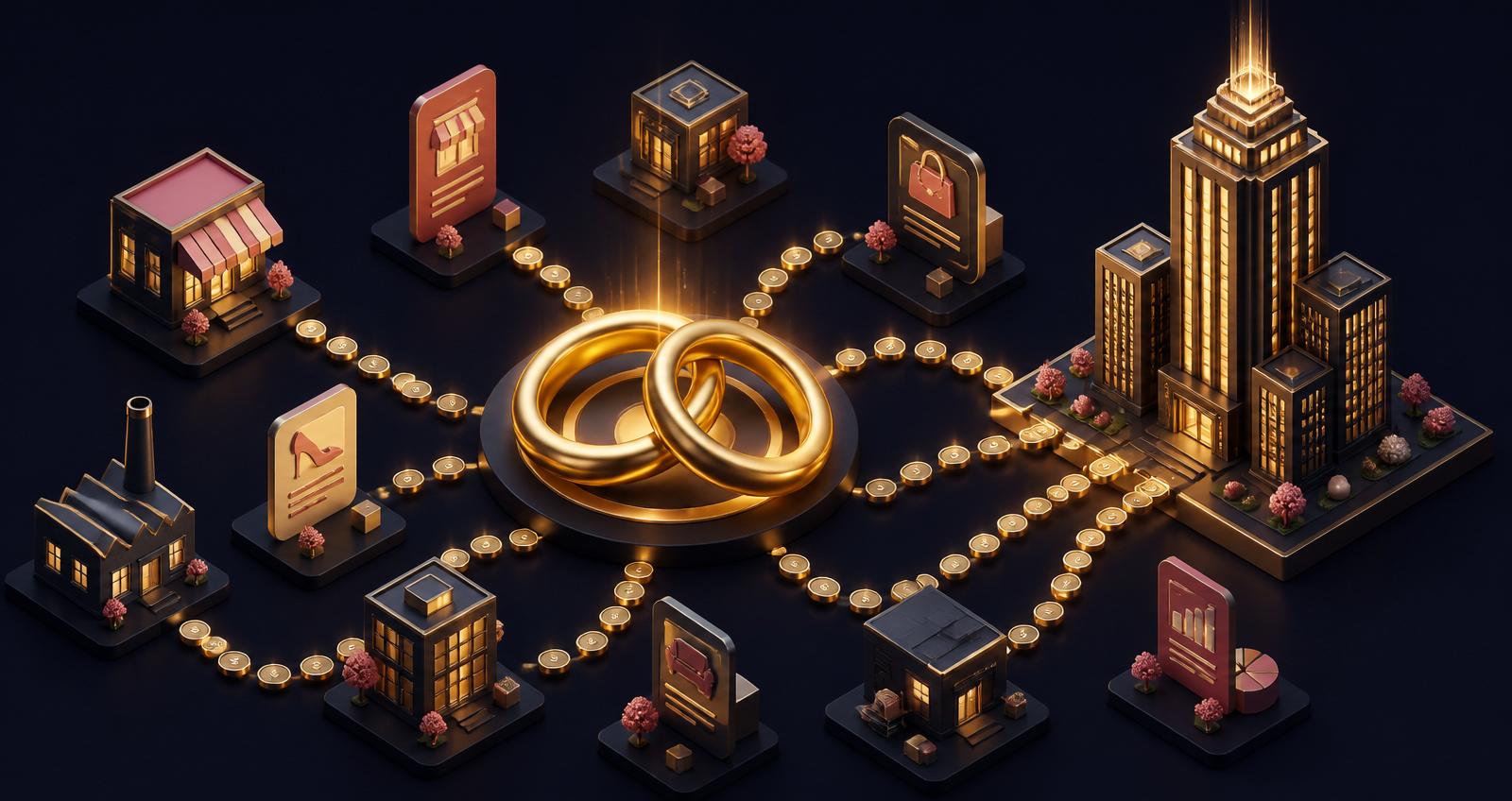
That era is over. What David's Bridal is building now is something the wedding industry hasn't seen before: a vertically integrated technology company that uses the dress as the entry point and the data as the real business.
The Pivot
The internal strategy is called "Aisle to Algorithm." It's not a marketing tagline — it's a genuine restructuring of what the company believes it is. Under CEO Kelly Cook and Silicon Valley veteran Elina Vilk, who joined as president to lead the transformation, David's Bridal has repositioned itself from bridal retailer to what it's now calling a "tech-powered multihyphenate."
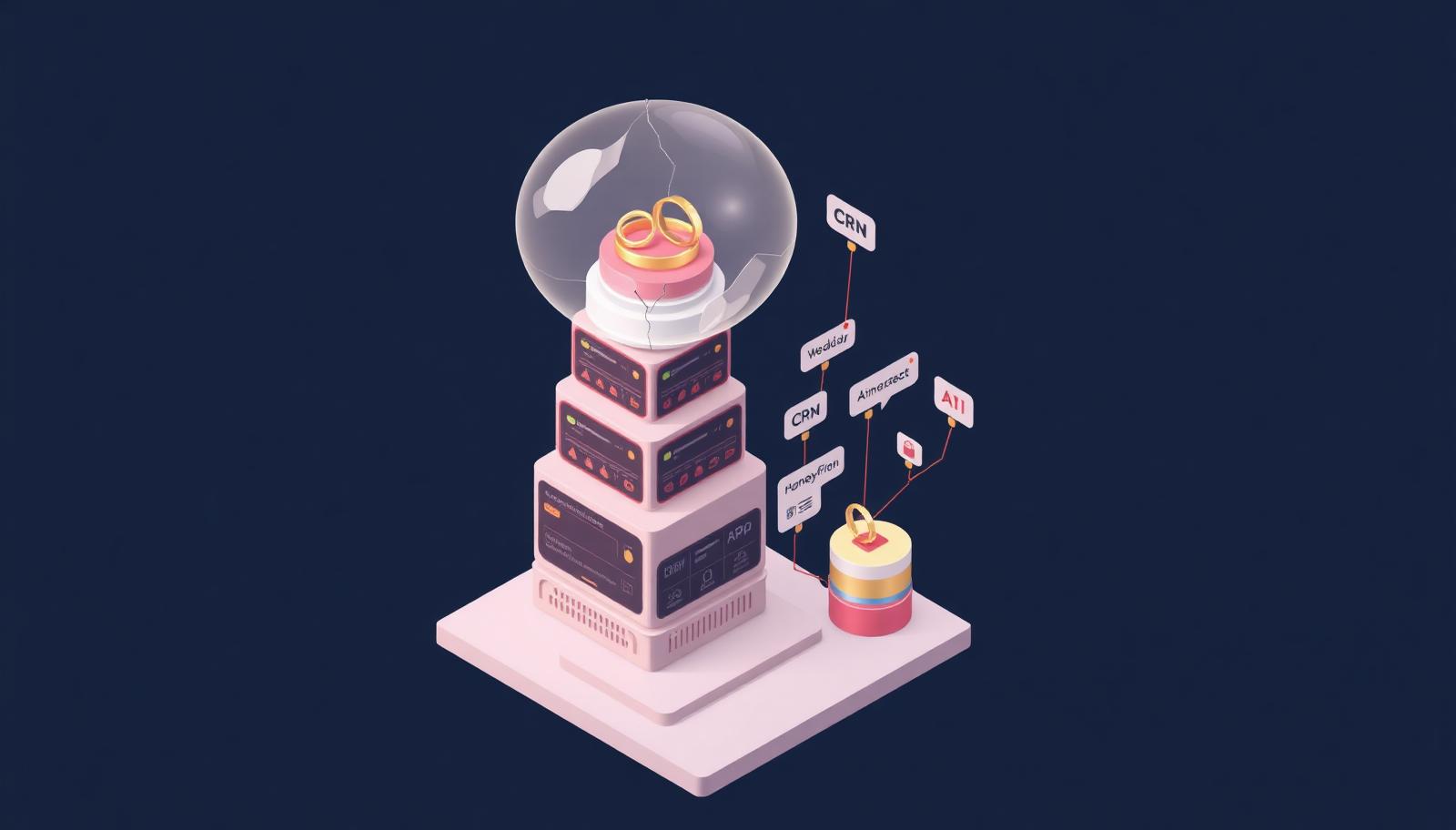
The centerpiece is Pearl Planner — a free, AI-powered wedding planning platform launched publicly in August 2025. The tool gives couples a single dashboard for their entire wedding: personalized timelines, task management, vendor recommendations, registry integration, a wedding website builder, and an AI assistant that adapts in real time to changes. Move the venue from Iceland to Aruba and Pearl automatically updates the checklist. Add ten guests and the seating chart adjusts. The system is trained on 75 years of David's wedding data, layered with real-time behavioural signals from across the platform.
Free to couples. Completely.
The revenue model sits on the other side: Pearl Planner Pro, which launched for professional wedding planners in late 2025, and a vendor subscription layer that charges professionals for placement, lead generation, and integration into the planning flow. And alongside it, Pearl Media Network — a targeted advertising business built on the planning data Pearl collects from couples as they move through the platform. David's isn't just building a product. It's building an audience, and then monetizing that audience's intent data.
Why This Is Different From What Came Before
The Knot has been the dominant wedding planning platform for two decades. WeddingWire has vendor directories that reach millions. Zola modernized the registry. None of them started with a physical retail footprint, a loyalty program, and direct access to the bride at the moment she says yes.
David's Bridal has 190 stores across North America. When a bride books a fitting appointment, she is automatically set up with Pearl Planner. The acquisition cost for that user is essentially zero — she's already a customer. The planning platform doesn't have to find her. She walks in the door.
That integration between physical retail and digital platform is genuinely novel in this space. The Knot Worldwide — which took The Knot and WeddingWire private in a $933 million transaction in 2019 — has no equivalent physical touchpoint. Pearl Planner gets new users through the fitting room. At scale, that's a structural advantage that's very hard to replicate.
The Content Layer
In February 2026, David's Bridal launched Breaking Bridal, a streaming docuseries following real couples through unique and unconventional weddings. The show launched on YouTube and the David's Bridal website, with distribution on Amazon Prime Video, Sling, Roku, and Tubi planned for later in the year.
This is not a marketing campaign. It's a content studio play. David's is betting that if it can own the cultural conversation around weddings — not just the logistics of planning them — it creates a gravity that pulls couples, vendors, and advertisers into one ecosystem. Pearl Media Network is the monetization layer sitting under all of it: advertising inventory sold against one of the most commercially valuable intent signals in consumer life.
The combination of planning data, retail data, loyalty program data, and streaming viewership data creates a targeting profile that most wedding vendors could never assemble independently. Retail media networks built on similar first-party data models — most notably Amazon's — have demonstrated that intent-signal advertising commands meaningfully higher CPMs than contextual or demographic-based inventory. That's the underlying financial logic of Pearl Media Network.
What It Means for the Vendor Side
For wedding vendors — photographers, florists, caterers, planners, venues — Pearl Planner presents a real strategic question. The platform's vendor recommendations are built into the planning flow, surfacing professionals at the moment couples are actively making booking decisions. That's valuable real estate.
But it's also a walled garden. Vendor visibility on Pearl is mediated by David's Bridal, which controls the algorithm, the placement, and the pricing. A vendor who builds their client pipeline on Pearl referrals is building on rented land — visible to couples inside the Pearl ecosystem, potentially invisible outside it.
The closest public market analogue is Angi Inc. (Nasdaq: ANGI), the home services marketplace that connects consumers with local professionals across 500+ categories, including wedding-adjacent services. Angi's market capitalisation has contracted from over $800 million in early 2025 to approximately $250 million by mid-2026 — a decline that reflects the structural difficulty of sustaining a vendor marketplace model when lead quality, pricing, and algorithm transparency are contested by the professionals paying for placement. Pearl faces an analogous tension, at an earlier stage.
Pearl Planner Pro also raises questions about where the platform's incentives ultimately sit. Professional planners build curated vendor relationships over years. A platform that algorithmically recommends vendors based on subscription tier and behavioural data changes the nature of that curation. Whether that produces a better outcome for the couple is a genuine open question.
The Numbers Behind the Bet
The U.S. wedding industry generates approximately $70 billion in annual spending. Roughly 2 million couples married in 2025, spending an average of $34,000 per wedding and engaging an average of 13 vendors to bring their day to life. Every one of those vendor decisions is a monetisable intent signal. Every one of those bookings is a potential subscription, a lead generation fee, an advertising impression, or a registry purchase.
David's Bridal filed for Chapter 11 bankruptcy protection in April 2023, its second such filing after an initial restructuring in 2018. What's different now is that the company appears to have genuinely concluded that the dress business alone cannot sustain the brand long-term — and that the data generated by the planning journey is worth considerably more than the margin on a gown. Pearl Planner is free because the planning data is the product. That's a well-established Silicon Valley playbook, applied to a 75-year-old bridal retailer at a moment when AI has made it technically feasible to execute at scale.
Whether it works depends on two variables: whether couples adopt Pearl as their primary planning hub rather than one of several tools in a fragmented stack, and whether vendors see sufficient return on Pearl subscriptions to sustain their participation. Both remain open questions. The platform has been publicly available for less than a year. But the structural foundation — physical retail acquisition, AI planning infrastructure, a media network, streaming content, and professional planner software — is more coherent than anything else the wedding industry has produced from an incumbent.
The Takeaway
David's Bridal is no longer competing for the dress sale. It's competing for the entire planning journey — and the data that journey generates. Pearl Planner is the interface. Pearl Media Network is the business. Breaking Bridal is the brand. And 190 fitting rooms across North America are the acquisition engine.
For anyone building in the wedding technology space, the David's Bridal pivot is the most significant structural move the industry has seen since The Knot and WeddingWire consolidated in 2019. Not because Pearl is a perfect product — it isn't yet — but because the company has access to distribution, brand trust, and physical infrastructure that pure-play digital platforms have to spend heavily to approximate.
The wedding industry just got a very well-resourced new entrant. And it arrived disguised as a dress store.
Footnotes & Sources
1. David's Bridal filed for Chapter 11 bankruptcy protection in November 2018 and again in April 2023, emerging from its second restructuring under private ownership with a reduced physical footprint and a technology-led mandate.
2. David's Bridal press release, June 24, 2025: "AI Meets 'I Do': David's Bridal Shakes Up $70B Wedding Industry With Launch of Pearl Planner" (Newswire).
3. David's Bridal press release, August 19, 2025: "From Vision to Vows: David's Bridal Officially Launches Pearl Planner" (Access Newswire).
4. Pearl Planner Pro announced for fall 2025 launch alongside the June 2025 preview of the dual-sided platform (Retail TouchPoints, June 24, 2025).
5. David's Bridal operates more than 190 stores across the U.S., Canada, and franchise locations in Mexico as of publication.
6. XO Group Inc. (NYSE: XOXO) / WeddingWire $933M take-private transaction announced September 25, 2018 (SEC Form 8-K); closed early 2019 under Permira Funds and Spectrum Equity as The Knot Worldwide.
7. The Philadelphia Inquirer, February 27, 2026: "David's Bridal is making a comeback with AI wedding planning tools and a new docuseries."
8. Amazon Advertising generated an estimated $56B in 2024, illustrating the CPM premium retail media networks command on closed-loop first-party intent data — the structural parallel to Pearl Media Network.
9. Angi Inc. (Nasdaq: ANGI) market data via public filings and PitchBook, Q2 2026: TTM revenue ~$1.02B (March 31, 2026), market cap ~$250M, price-to-sales below 0.25x.
10. U.S. wedding industry annual spend of ~$70B per David's Bridal investor communications and IBISWorld sector reporting.
11. The Knot Worldwide 2026 Real Weddings Study (n>10,000 U.S. couples): average spend $34,000; average 13 vendors hired per wedding.
12. David's Bridal Chapter 11: first filing November 2018 (emerged January 2019); second filing April 2023 (emerged June 2023 under new ownership).
Related: The Wedding Bubble Is Good for Wedding Tech at The Wedding Bubble Is Good for Wedding Tech, and Update: David's Bridal Still Believes in the Dress at Update: David's Bridal Still Believes in the Dress.
WeddingSaaS.com covers the business of wedding technology. Editorial content is independent and not sponsored. For inquiries, contact the team at weddingsaas.com.