Yesterday, the Washington Post published a piece arguing that the American wedding industry is heading for a collapse. The thesis: weddings have become a luxury product pricing out the average couple, the economics look like a bubble — same fingerprints as 2008 housing, same fingerprints as dot-com — and when it pops, what's left won't be cheaper. It'll just be worse.
They're not wrong about the economics. But they're writing the wrong story.
The right story isn't about collapse. It's about what happens to a $100 billion industry when the margin gets squeezed from every direction at once — and who captures the opportunity when it does.
What's Actually Happening
The numbers are not subtle. Eighty-five percent of couples say the economy impacted their wedding planning in 2025. Thirty-seven percent had to contact more vendors than they originally planned — which means the discovery and booking process is broken, expensive, and time-consuming in ways that are costing both couples and vendors real money. Tariffs are projecting a 10–15% cost increase across gowns, florals, linens, and rentals through 2026 and into 2027. The average wedding already costs $34,000. Median age at first marriage is now 30.8 for men and 28.4 for women — up more than seven years since 1975 — which means couples are older, more financially literate, and considerably less willing to absorb opaque pricing and inefficient vendor processes.
This is not a market in retreat. It's a market under pressure. And markets under pressure do one of two things: they consolidate around the players with structural advantages, or they get disrupted by whoever shows up with a better model.
In the wedding industry, the better model is software.
Why Pricing Pressure Accelerates Tech Adoption
There's a pattern that repeats across industries when margins compress. It happened in real estate after 2008 — Zillow, Redfin, and a generation of prop-tech companies built their entire businesses on the dislocation. It happened in restaurant delivery when COVID collapsed the hospitality industry's margins overnight — Toast, Square, and a dozen platforms came out stronger on the other side. It happened in healthcare when insurance pressure pushed providers toward practice management software and revenue cycle automation.
The pattern is consistent: pain creates urgency. Urgency creates adoption. Adoption creates data. Data creates moats.
The wedding industry is entering that phase right now.
When a vendor is absorbing tariff increases on imported florals, dealing with a shrinking pool of available talent, and competing on a directory platform that charges subscription fees regardless of booking outcomes, the math on "just keep doing it manually" starts to break. The calculus shifts. Suddenly, the CRM that automates follow-ups, the pricing tool that updates quotes in real time, the marketplace that surfaces verified vendor reviews instead of paid placements — these aren't nice-to-haves. They're survival infrastructure.
The couples are already there. AI adoption in wedding planning nearly doubled year-over-year, reaching 36% in 2025. A third of couples are using AI tools to draft vendor emails, build timelines, and research options. They're not going back to spreadsheets. The vendors who meet them where they are will book more weddings. The vendors who don't will wonder why their inquiry rate is falling.
The Specific Opportunity
The WaPo piece makes one observation that deserves more attention than it got: when the bubble bursts, it won't play out evenly. Venues hold hard assets and will survive. Photographers have transferable skills. But the middle layer — coordinators, stylists, mid-tier planners — faces the most structural risk. These are also the professionals most underserved by existing wedding tech platforms, which were largely built for either the couple side or the enterprise venue side, not the working professional trying to run a small business.
That gap is where the real SaaS opportunity lives in 2026.
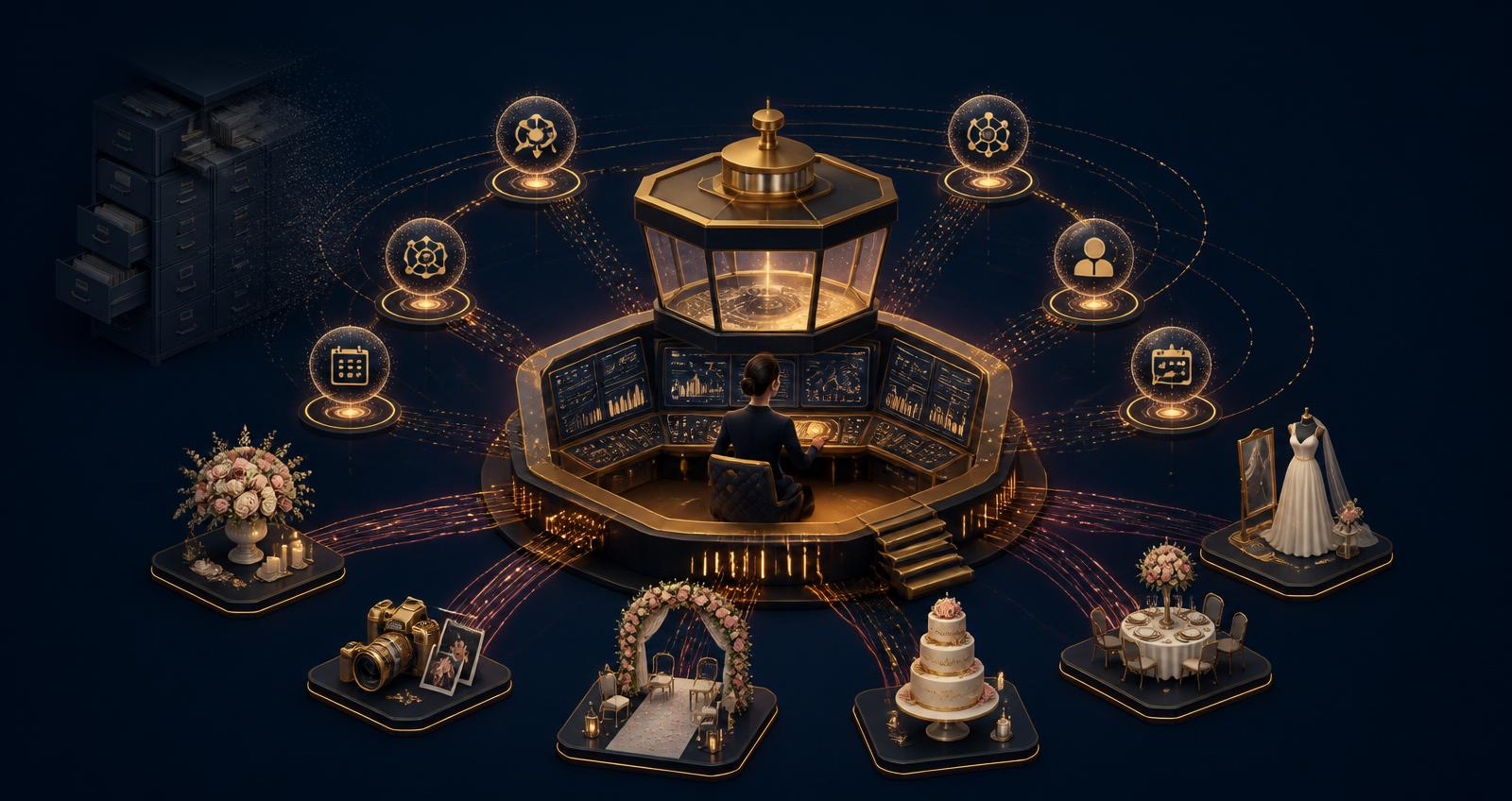
A platform that gives mid-tier wedding professionals — coordinators, photographers, florists, DJ companies — real business infrastructure: transparent pricing tools, automated client communication, contract management, booking analytics, and access to verified vendor networks, is building in exactly the right place at exactly the right time. Not because the market is growing. Because the market is getting harder, and harder markets reward the players with better tools.
The wedding industry doesn't need another directory. It needs operating software. The pressure the WaPo is describing is the forcing function that makes that case for you.
What the Bubble Piece Gets Wrong
The cultural argument — that society has stopped valuing the marriage and started fetishizing the wedding — is interesting but incomplete. It treats the symptom as the disease.
Couples aren't overspending on weddings because they're irrational. They're overspending because the information environment is broken. Social media surfaces the most elaborate 1% of weddings as the norm. Pricing is opaque. Vendor comparison is painful. There's no trusted, transparent marketplace where a couple with a $20,000 budget can efficiently find vendors who deliver at that level and have the reviews to prove it.
Fix the information environment and you fix a significant portion of the overspending problem. That's not a cultural intervention. It's a product problem. And product problems have product solutions.
The bubble the WaPo is describing was partly built by the absence of good wedding tech. The platforms that existed captured the top of the market or optimized for vendor advertising revenue rather than couple outcomes. The result is exactly what you'd expect: misaligned incentives, opaque pricing, frustrated couples, and vendors who can't figure out why their conversion rate is declining.
The collapse, if it comes, won't be the end of the wedding industry. It'll be the end of that model. And the platforms that replace it will be the ones that were already building the right infrastructure before the reset happened.
The Timing
Peak wedding season. A Washington Post piece arguing the industry is a bubble. Tariff pressure hitting vendor costs. AI adoption doubling in a single year. The Knot rebuilding its entire C-suite. David's Bridal pivoting to become a tech company.
This is not a quiet moment for wedding SaaS. It's the setup.
The companies that move now — that build transparent pricing infrastructure, real vendor verification, AI-powered planning tools that actually reduce cost rather than just automate checklists — will be the platforms that own the next decade of this industry.
The bubble is good for wedding tech. Not because collapse is good. Because the pressure that precedes it is exactly what finally makes the market ready to adopt the tools it should have had ten years ago.
Related: David's Bridal Is No Longer a Dress Company — And the Wedding Tech Industry Should Pay Attention at David's Bridal Is No Longer a Dress Company — And the Wedding Tech Industry Should Pay Attention (Analyst Edition), and Update: David's Bridal Still Believes in the Dress at Update: David's Bridal Still Believes in the Dress.
References
- Washington Post — analysis of the American wedding industry as a pricing bubble (July 2026).
- The Knot Worldwide — Real Weddings Study 2025: 85% of couples say the economy impacted planning; 37% contacted more vendors than planned. theknotww.com
- US tariff impact on bridal/floral/rental imports projecting 10–15% cost increases through 2026–2027 — industry vendor surveys.
- US Census Bureau — median age at first marriage: 30.8 (men), 28.4 (women), 2024 update. census.gov
- AI adoption in wedding planning reached 36% in 2025, nearly doubling year-over-year — The Knot 2025 planning trends.