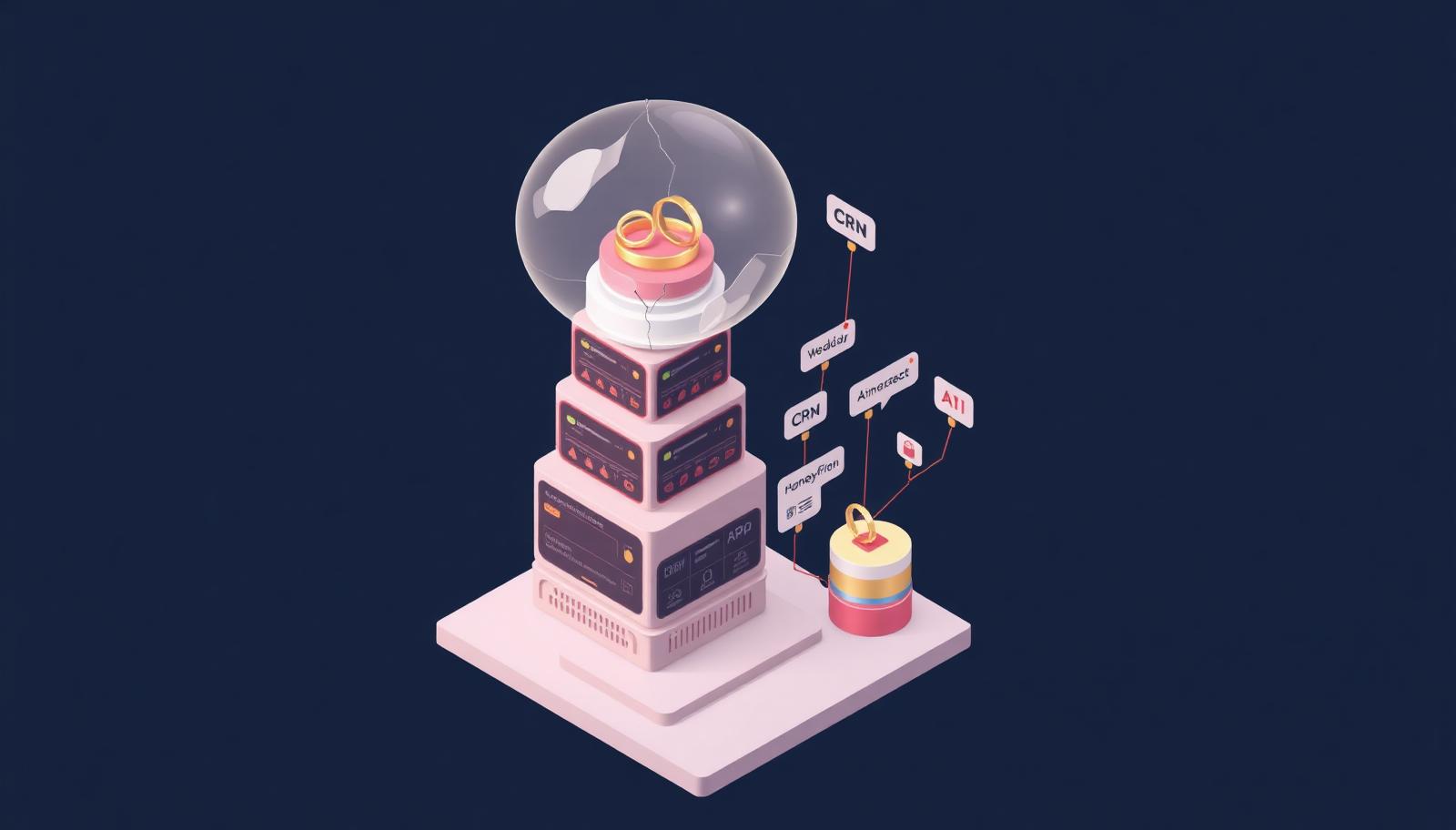
Is a "WeddingSaas-pocalypse" coming? The broader SaaS world spent the first half of 2026 grappling with that very question after a mass market selloff erased over $1 trillion in software stock value. And while analysts are increasingly optimistic that the worst is behind the industry, the wedding technology sector faces its own version of this inflection point — one shaped by AI coding tools, sprawling vendor stacks, and a new generation of couples who expect digital-first experiences from day one.
The global wedding planning software market reached $1.52 billion in 2024 and is projected to grow at a 13.1% compound annual growth rate through 2033, potentially reaching $4.37 billion. That trajectory is promising — but the underlying dynamics are shifting fast.
How Real Is the Disruption?
Across the broader SaaS landscape, many industry veterans are arguing that fears have been overstated. In June 2026, Business Insider executive editor Joe Ciolli argued the SaaSpocalypse is "dead," citing a 13% rebound in software stocks. Thoma Bravo's Orlando Bravo called AI "an enormous tailwind for software companies."
The same tension exists in wedding tech. AI coding tools like Claude Code and OpenAI's Codex have dramatically lowered the barrier to building functional software. A solo developer — or even a non-developer using a "vibe coding" interface — can now prototype a guest management app, a vendor payment tracker, or a seating chart tool in an afternoon. That is a genuine threat to narrow, single-feature wedding SaaS vendors.
As Terra Higginson, Principal Research Director at Info-Tech Research Group, put it: "Those guys are in trouble right now. They don't own a lot of the workflow, they don't own a lot of the transaction, they don't own a lot of the data — and they're easy to replicate through vibe coding."
Applied to wedding tech, this is a direct warning for single-purpose tools: a standalone RSVP tool, a basic seating chart app, or a simple inquiry form builder are exactly the kind of narrow utilities that AI can replicate in minutes. The wedding industry has historically been served by a patchwork of these single-function tools — and that era may be ending.
Where Wedding Tech Platforms Are Safer
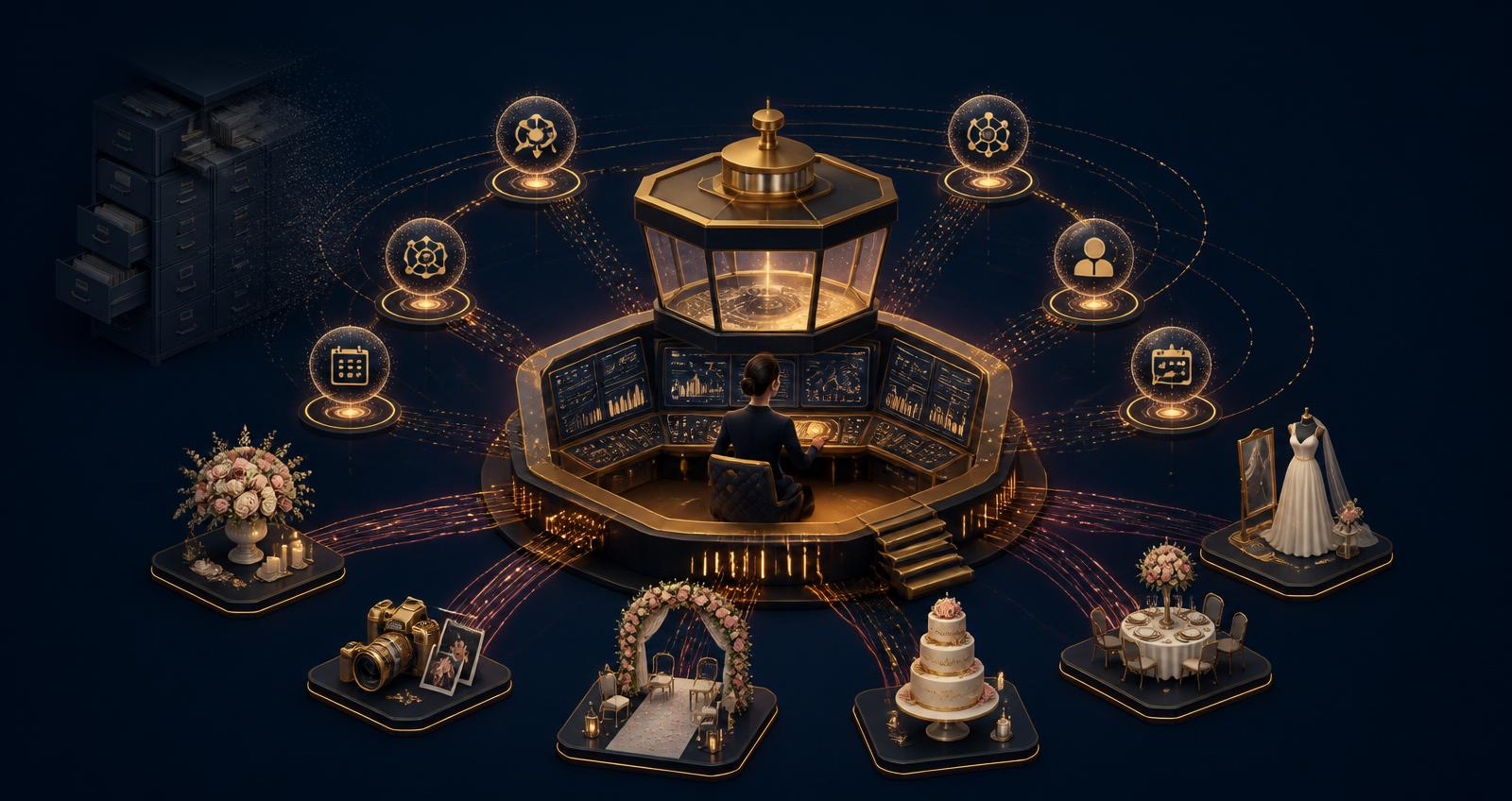
The picture looks far more stable for comprehensive platforms that are deeply embedded in a planner's or vendor's daily operations. Platforms like HoneyBook, Aisle Planner, and newer entrants like Wedy Pro and Ripluo combine CRM, invoicing, contracts, timelines, and client communication in ways that are genuinely difficult to replicate with a quickly assembled AI-coded app.
Consider what a wedding planner actually needs: a system that manages 6–18 month planning timelines, coordinates 10–14 external vendors per event, handles legally binding contracts, processes high-value payments, and maintains a polished client-facing experience — all while the planner is often on-site at other events. That is not a "vibe coded" prototype. That is an ecosystem.
Ray Shu, Senior Managing Director at Capital One Technology Banking, framed it well: "The ability to generate code quickly does not replace the role enterprise software plays within large organizations. Companies are not simply purchasing features; they are investing in reliable systems that are embedded in workflows and designed to operate at scale."
The same principle applies at the scale of a boutique wedding planning studio. The value isn't just in the feature list — it's in years of client data, vendor relationships, workflow automations, payment histories, and the compliance requirements around contracts and payments. A vibe-coded alternative starts at zero on all of those dimensions.
AI as a Feature, Not Just a Threat
The smarter wedding SaaS vendors aren't just defending against AI disruption — they're embedding AI directly into their products. HoneyBook AI, available on Essentials plans and above, now drafts emails and delivers daily briefings of pending tasks and follow-ups. Ripluo has launched "Buildr AI," described as the first AI assistant in the event planning category that generates full schedules, checklists, and emails from event context.
AI adoption among couples nearly doubled to 36% in 2025, reshaping client expectations around responsiveness and personalization. A wedding planning platform that doesn't leverage AI for faster client communication, automated follow-ups, or intelligent scheduling will increasingly feel dated to couples who are themselves using AI to research vendors, draft emails, and compare options.
The parallel in the broader market is instructive. Salesforce — hardly a company facing extinction — has rebuilt its entire CRM around what it calls an "agentic experience," designing for a world where AI agents and human planners collaborate in real time. Leading wedding platforms will need to make the same philosophical shift: not just adding AI features, but designing their products for a planning experience where AI assistance is woven throughout.
The Sprawl Problem: Wedding Tech's Specific Challenge
One of the most acute problems in wedding SaaS right now is tool sprawl. A typical professional wedding planner in 2026 might run Aisle Planner for timelines and checklists, HoneyBook for contracts and invoicing, QuickBooks for accounting, Canva for design direction, and a separate email platform — all while coordinating vendors across multiple messaging threads.
The combined cost of Aisle Planner ($30–70/month), HoneyBook ($19–79/month), and QuickBooks ($30/month) can reach $79–180/month — and none of these tools share data. Vendor details entered in one platform don't appear in another. Timeline updates don't cascade across tools. Each new event means re-entering information manually.
This is the wedding industry's version of the SaaS sprawl problem affecting organizations everywhere. According to BetterCloud, companies still average 106 SaaS apps even after recent consolidation cycles, and 70% of IT leaders prefer unified platforms over disconnected point solutions. For a solo wedding planner or a small studio, the cost of this fragmentation isn't measured in IT overhead — it's measured in hours lost to manual coordination and the risk of a dropped detail on someone's wedding day.
Consolidation: The Opportunity for Comprehensive Platforms
The pressure toward consolidation is creating a genuine market opportunity. All-in-one platforms that can replace a planner's four-tool stack with a single subscription — at a competitive price point — are well-positioned to capture share as planners scrutinize their software costs more carefully.
Consolidating multiple tools into a single platform can save planners $60–160 per month in software costs alone, while recovering 5+ hours per week currently lost to manual coordination between disconnected tools.
But consolidation isn't just about cost savings. It's about owning the workflow. As the broader market has shown, vendors that own the complete transaction — the data, the timeline, the communication, the payment — are far more resilient to disruption than those that own just one piece of it. In wedding terms, a platform that is the place where the contract is signed, the payment is processed, the seating chart is built, and the day-of timeline lives is not easily replaced.
Krishna Sai, CTO of SolarWinds, put it plainly: "The future of SaaS will be determined by the value vendors deliver, not the hype they generate. Customers are scrutinizing every renewal now, and they're asking a very simple question: what did this actually do for us? Hype doesn't survive that question. Value does."
Build vs. Buy: A New Calculation for Wedding Businesses
AI has reignited the classic build-versus-buy debate across every industry, and wedding businesses are no exception. A venue, a large catering company, or a multi-location bridal chain might now ask: should we build our own booking and management system rather than pay subscription fees to a third-party platform?
The honest answer is nuanced. AI coding tools have dramatically lowered the cost of building a first version of almost anything. A prototype CRM for a wedding venue is a realistic afternoon project with the right AI tools. But a prototype is not a product.
"Creating an application is trivial compared to maintaining it through time," Jeremiah Stone, CTO of SnapLogic, noted in the broader SaaS context. That observation applies with full force to wedding tech. A custom-built booking system needs ongoing security patching, payment processing compliance, mobile optimization, integration with email platforms, and feature updates to keep pace with competitor platforms — all of which require sustained engineering investment that most wedding businesses cannot justify for non-core software.
CRM software delivers an average return of $8.71 for every $1 invested and can increase revenue by up to 245% post-implementation — a figure that makes the subscription cost of a well-chosen platform look very different from the perspective of ROI rather than just monthly spend.
What This Means for Wedding SaaS Vendors in 2026
The wedding tech landscape is entering a period of meaningful consolidation and differentiation. Single-feature tools that don't own a meaningful slice of the planning workflow are most vulnerable to being replaced — either by AI-generated alternatives or by comprehensive platforms that can absorb their functionality.
Platforms that survive and thrive will be those that can articulate clear, measurable value: time saved, revenue generated, client satisfaction delivered. They will embed AI not as a marketing feature but as a genuine workflow accelerator. And they will design their products not just for today's planner but for a planning experience that increasingly involves AI agents collaborating alongside human coordinators.
The WeddingSaas-pocalypse, if it comes, will be selective. The vendors who understand what they actually own — the data, the workflow, the relationship — will not just survive it. They'll grow through it.
Related: The Wedding Bubble Is Good for Wedding Tech at The Wedding Bubble Is Good for Wedding Tech, and The Knot's AI Monopoly Actually Accelerates the SaaS Opportunity at Why The Knot's AI Monopoly Actually Accelerates the SaaS Opportunity.
References
- Joe Ciolli — "The SaaSpocalypse is dead," Business Insider, June 2026. businessinsider.com
- Grand View Research — Wedding Planning Software Market Size Report, 2024–2033. grandviewresearch.com
- HoneyBook — HoneyBook AI on Essentials plans and above, product documentation 2026. honeybook.com
- Ripluo — Buildr AI launch, event planning AI assistant, 2026. ripluo.com
- The Knot — Real Weddings Study 2025: average 13–14 vendors hired per wedding, 36% AI adoption in planning.
- BetterCloud — 2026 State of SaaSOps report: average 106 SaaS apps per company, 70% prefer unified platforms. bettercloud.com
- CRM.org — CRM Software ROI Statistics: $8.71 return per $1 invested, up to 245% revenue lift. crm.org