HoneyBook announced its Model Context Protocol interface on August 19, 2026, describing access to account records and authorised actions through compatible AI assistants, with Claude as its initial verified connector. On September 9, the company announced its ChatGPT connection. Together, these releases make the shift from general advice to account-specific assistance a timely wedding-business story. 12
The angle is practical: a planner, photographer or venue manager needs an answer grounded in the actual project. A fluent response about typical wedding workflows is not the same as knowing whether this couple returned a questionnaire or whether this booking has an outstanding task.
What the announcements establish
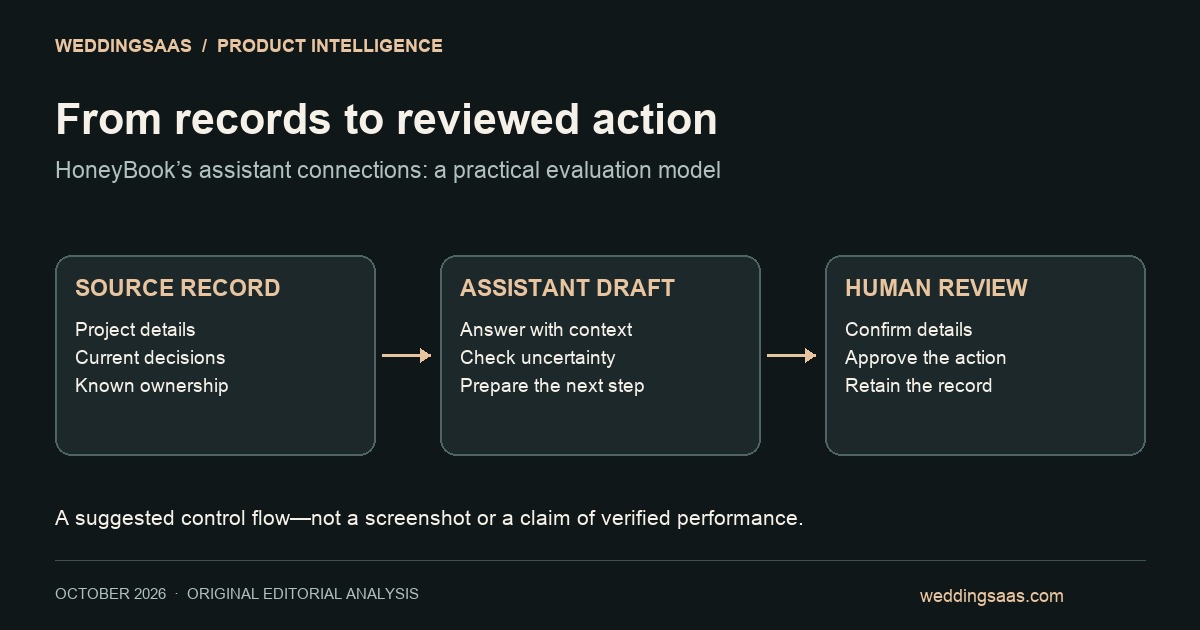
HoneyBook’s September announcement describes questions across projects and the preparation of forms, proposals and other business documents. It says AI-created work remains subject to user review and approval. Its August announcement describes resource-specific permission and an interface intended for compatible clients. These statements describe the vendor’s intended operation; WeddingSaaS has not independently tested the integration. 12
The company’s help documentation is the appropriate starting point for current setup details, supported access and limitations. Account eligibility, assistant availability and permissions should be checked there rather than inferred from an article headline. 3
The first useful question is small
Start with a question whose answer you can check quickly against a known project. For example: which of three sample projects has an unanswered questionnaire? Ask for the underlying record and date, then compare the answer with the source. This exposes ambiguous project names and incomplete data before they become client-facing mistakes.
Next test a situation that requires context rather than a keyword match. A wedding date may appear in an enquiry, a proposal and an amendment. Ask which record supports the answer. A responsible workflow should make uncertainty visible when the records disagree instead of silently treating the first match as definitive.
These are our suggested evaluation steps, not claims about failures in HoneyBook. They apply to any assistant connected to a CRM. The goal is to establish what your own data and process can support.
Permission is a workflow decision
A read-only planning session and sending something to a client are different tasks. Decide who may access which records, who reviews a draft and who authorises the next action. Keep those responsibilities clear even when one person runs the whole business.
For a team, use a sample event to walk through handoff: the sales lead drafts a response, the event manager checks scope, and the authorised sender approves it. Ask where that approval is recorded. Test how access is removed when a team member or outside assistant no longer needs it. The answer should be understandable without relying on a confident-sounding chatbot response.
Do not use speed alone as the success measure. Track corrected details, time spent checking source records and whether a draft was useful enough to retain. An assistant that saves ten minutes of typing but creates fifteen minutes of verification has not yet improved that task.
Clean project records become more valuable
Our interpretation is that assistant access raises the value of consistent records. Use distinct project names, current dates, clear ownership and a known place for approved changes. Mark superseded information so a reader—human or software—can distinguish it from the current plan.
A wedding team can begin this work without buying anything new. Review one completed event and identify where the final guest count, arrival time, service scope and client decisions were actually recorded. If the answer is several disconnected threads, the immediate opportunity is better organisation. An AI connection should build on that clarity rather than hide its absence.
What wedding SaaS builders should take from this
For competing software makers, the question is becoming whether useful information can be reached and acted on with appropriate control. A conversational interface is only one part of that. Clear data, permissions, records of changes and recovery paths are product work too.
We see the opportunity in narrow, testable jobs: prepare an event brief with source references; identify records that need attention; assemble a draft from approved information. Proving one of those jobs works is stronger than promising a fully autonomous wedding business. For our earlier strategic discussion, see Wedding SaaS Isn't Dying. It's Becoming the Control Layer for Agentic AI..
Reporting note
Primary sources were checked October 6, 2026. This article separates HoneyBook’s announcements from our proposed evaluation framework. It is not a hands-on review or a claim that every account has identical access. WeddingSaaS is published by Weddings.io Technologies, which operates in the wedding technology sector.
References
- HoneyBook, August 19, 2026. MCP launch announcement. Introducing the HoneyBook MCP
- HoneyBook, September 9, 2026. ChatGPT integration announcement. HoneyBook’s ChatGPT announcement
- HoneyBook Help Center. Connector scope and limitations, checked October 6, 2026. About the HoneyBook connector