Most software companies enter a vertical with a pitch about productivity. Cleaner contracts. A prettier dashboard. Fewer clicks to send an invoice. These are real improvements, and real wedding vendors appreciate them. But they are not the reason a photographer tells every person in their Facebook group to switch platforms the week they sign up.
The reason is money. Specifically: the money that was stuck, and then wasn't.
The wedding industry sits in a peculiar financial position. It moves roughly $57 billion through the U.S. economy each year, and almost none of the infrastructure serving it was designed for it. Independent photographers, planners, florists, and DJs — the people who actually produce a wedding — have historically been handed tools built for dentists, contractors, or retail boutiques. The fee structures, payment cadences, and underwriting models behind those tools assume a business that bears no resemblance to a seasonal creative operating on multi-month booking cycles.
The Blindspot: A $57 Billion Market Running on Checks and Crossed Fingers
Here is what the data looked like to anyone paying attention. Couples spending over $40,000 on a single event were increasingly unable to pay vendors without reaching for high-interest credit cards. Around 74% of them were doing exactly that. Meanwhile, the vendors receiving those payments were losing 3% to 4% of every dollar to processing fees — on top of the hours spent chasing milestone payments, managing unsigned contracts, and absorbing the cash flow uncertainty of a business that earns most of its revenue in a six-month window.
Neither side of the transaction was being served well. And the software tools nominally designed to help — generic invoicing platforms, horizontal CRMs — weren't built to solve financial problems. They were built to solve organizational ones. The question isn't what workflow can we improve. It's where does money get stuck — and how do we become the solution to that before we're anything else.
The Entry Strategy: Lead With Liquidity, Not Features
The fintech-first playbook turns the standard SaaS go-to-market inside out. Rather than offering a free trial of productivity tools and hoping the calendar and contract features are good enough to stick, you enter the market with a financial instrument. You solve the most painful problem first — the one that keeps vendors up at night — and let the software layer follow.
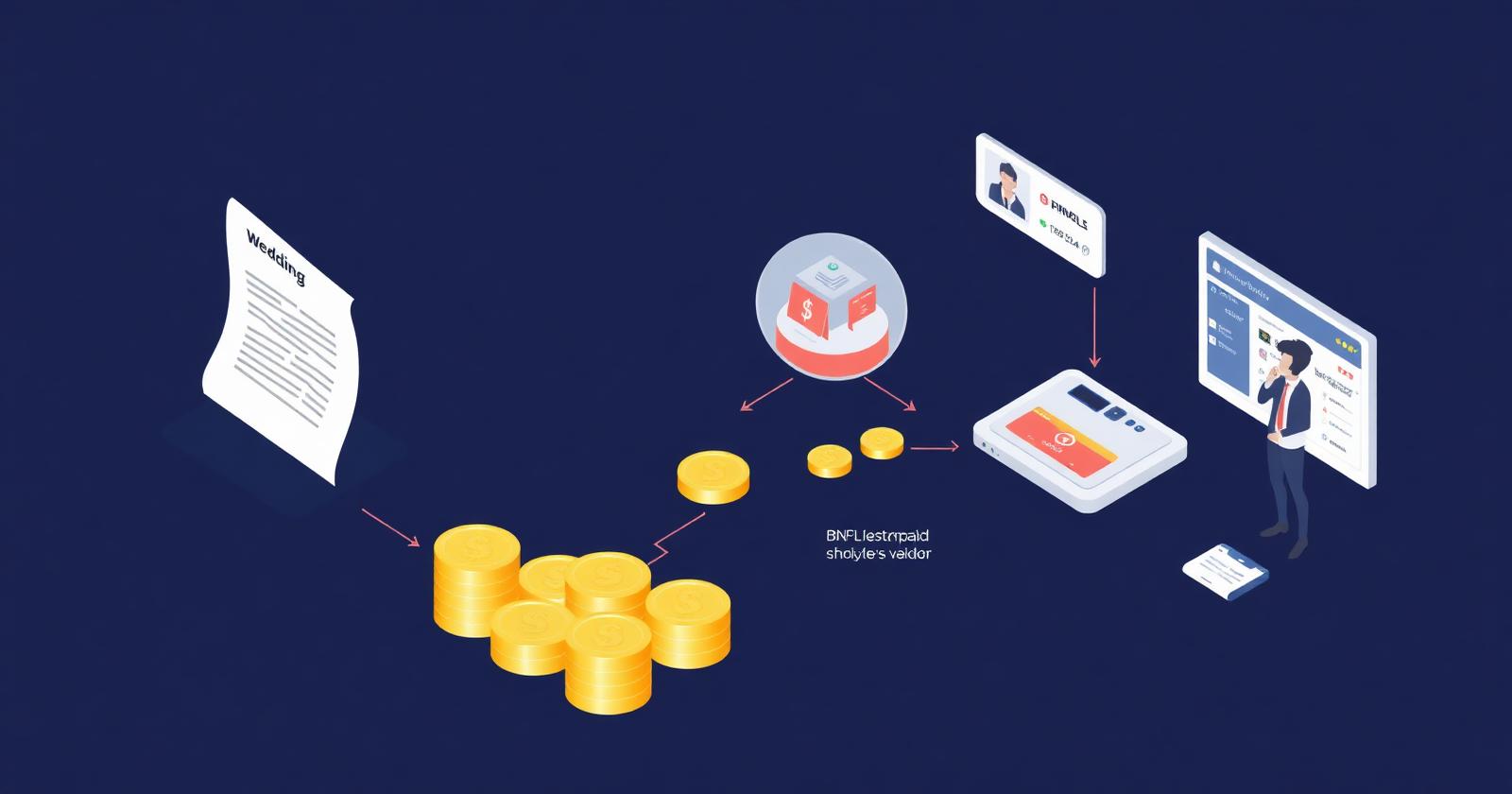
In the wedding market, that instrument is instant vendor payout. When a couple books a $12,000 photographer using a Buy Now, Pay Later structure — splitting their balance into predictable monthly installments at 0% APR — the photographer doesn't wait for the couple to pay over time. They receive the full $12,000 within one business day of the signed contract. The platform holds the receivable. The vendor goes back to shooting weddings.
This is not a feature you explain on a demo call. It is a category shift. You are not competing with another invoicing tool. You are competing with the stress of seasonal cash flow uncertainty — and winning before a prospect has seen a single screenshot of your product.
The Financial Architecture: Building the Rails That Make It Work
Executing this requires a different kind of infrastructure than a typical SaaS launch. Three components are non-negotiable.
The first is a structured debt facility. You are not using equity to fund vendor payouts — that path dilutes ownership and moves too slowly. You need a dedicated credit facility sized to your expected transaction volume, secured early, and structured around the characteristics of wedding contract receivables. Those receivables are unusually safe: a couple has signed a legal contract, has a fixed event date, and carries strong personal and social incentives to pay. Default risk is materially lower than consumer BNPL broadly, and your underwriting model should reflect that.
The second is fee architecture. Standard 3% to 4% merchant fees are not just a margin problem for vendors — they are a symbolic one. A photographer charging $5,000 doesn't think in basis points. They think in the $175 that disappears from a single booking, and the $3,500 that disappears across a season. Giving vendors the ability to pass processing fees transparently to clients, or route transactions over ACH at zero cost, hands them back real money. That is a word-of-mouth engine, not just a feature bullet.
The third is cancellation protection. Embedding event insurance directly into the payment flow — covering scenarios like severe weather, military deployment, or sudden job loss — is what makes couples comfortable committing to a large installment plan. You are not just offering flexible payment terms. You are removing the downside risk that made those terms feel precarious.
The Distribution Logic: Why Trust Is the Only Channel That Matters
The wedding vendor market is tribal in the best sense. Photographers trust photographer recommendations. Planners build referral networks with caterers. Florists and DJs cross-promote on Instagram before they've ever met in person. A single respected voice in a regional Facebook group can drive more signups in a week than a well-funded paid acquisition campaign would produce in a quarter.
This means your founding team composition is a strategic variable, not just an HR one. The most effective distribution path into the wedding industry is through someone who already lives inside it — a former platform executive, a respected educator, a longtime industry columnist. Their institutional relationships are worth more than your first several hundred thousand dollars in marketing spend, and they convert skepticism into curiosity in ways that no ad creative can replicate.
It also means targeting the educators and community organizers who shape vendor opinion — podcast hosts, workshop facilitators, the person who moderates the 40,000-member photographer group. Put them on the platform early, build referral economics that reward them generously, and let the network do the rest.
The Compounding Effect: How the Flywheel Locks In
The reason this model compounds faster than a conventional SaaS play is that each part of it feeds the next. Once the mechanism is running, it becomes genuinely difficult to disrupt from the outside.
The fintech-first growth loop: (1) Vendor joins for instant payout — day-one value is financial, not organizational. (2) Couples use BNPL to book more vendors — larger budgets unlock, more bookings flow through the platform. (3) Vendor categories cascade in — planners refer florists, florists refer caterers, network effects multiply. (4) Transaction volume grows — larger debt facility unlocks at better rates, economics improve. (5) Platform becomes default financial infrastructure — trust, data, and network depth make switching costly.
By the time a competitor achieves feature parity, you own the financial relationship between vendors and couples across hundreds of weddings. You have the transaction data. You have the referral network. You have the contract-to-invoice history that makes every adjacent financial product — working capital loans, equipment financing, business insurance — a natural extension rather than a cold pitch.
Feature parity is achievable in months. Trust and financial infrastructure parity takes years. That asymmetry is the entire thesis. The gap wasn't a feature request. It was a company — and whoever builds the bridge between vendor cash flow and couple affordability first owns the market.
Editorial Perspective
The wedding industry has been waiting for someone to build this bridge not because it lacked smart founders, but because the solution required holding two things in mind simultaneously: deep domain knowledge of how creative businesses actually operate seasonally, and the financial engineering background to build lending infrastructure from scratch. Those competencies rarely appear together. When they do, the window is narrow and the incumbents are slow.
The window is open now. The question is whether the next entrant treats it as a software problem or a capital problem. The answer to that question will determine who owns the category.
Key Data Points
U.S. wedding industry size: ~$57 billion annually. Average U.S. wedding cost: $40,000+. Couples taking on debt to book vendors: 74%. Standard merchant processing fees eating vendor margins: 3–4% per transaction. Typical fintech-first vendor payout window: within 1 business day of signed contract. BNPL structure most common in the vertical: 0% APR fixed monthly installments over the engagement period. Wedding-contract BNPL default profile: materially lower than consumer BNPL broadly due to signed contracts, fixed event dates, and social payment incentives.
References
- The Knot 2025 Real Weddings Study — U.S. wedding spend and payment behavior. theknot.com
- LendingTree — Wedding debt and financing survey, 2025. lendingtree.com
- Federal Reserve — Consumer credit and BNPL adoption trends, 2025. federalreserve.gov
- Merchant Payments Ecosystem — Vertical SaaS embedded finance benchmarks. mpe-congress.com
- a16z — The rise of vertical fintech infrastructure. a16z.com